You know, this thing is really rather shiny.
2018-08-13
Good marks2018-08-07
Dreadful Birthday!Die Antwort auf die Frage nach dem Leben, dem Universum und dem ganzen Rest ist 42.
Die Antwort auf das andere Ende ist anscheinend 41. Absolutely beautiful.
2018-08-04
pywin32https://github.com/mhammond/pywin32.git
How to build pywin32 with current Visual Studio:
- Install Visual Studio 2017. Include the Windows 8.1 SDK.
- Start VS developer command prompt
git clone https://github.com/mhammond/pywin32.gitset MSSDK_INCLUDE=C:\Program Files (x86)\Windows Kits\8.1\includeset MSSDK_LIB=C:\Program Files (x86)\Windows Kits\8.1\lib\winv6.3\umpython.exe setup.py build- Sacrifice a small domestic or farmyard animal
python.exe setup.py build- If you want it badly enough, try scaling up the sacrifices. It won’t help, though.
And remember: To make a debug build, you not only have to have the debug version of Python installed, but you must use it to run setup.py .
2018-08-02
site-packagesMore Python shenanigans.
C:\Daten>py -3.6 -c "import sysconfig; print(sysconfig.get_path('platlib', 'nt_user'))"
C:\Users\me\AppData\Roaming\Python\Python36\site-packages

C:\Daten>py -3.6-32 -c "import sysconfig; print(sysconfig.get_path('platlib', 'nt_user'))"
C:\Users\me\AppData\Roaming\Python\Python36\site-packages
Am I missing something? Otherwise, would someone please explain why this was considered anything but a recipe for disaster?
Let me illustrate …
C:\Daten> py -3.6 -m pip install --user pywin32
[... installs ... ]

C:\Daten> py -3.6-32 -m pip install --user pywin32
[...]
Requirement already satisfied: pywin32 in C:\Users\me\appdata\roaming\python\python36\site-packages (223)

C:\Daten> py -3.6-32
Python 3.6.6 (v3.6.6:4cf1f54eb7, Jun 27 2018, 02:47:15) [MSC v.1900 32 bit (Intel)] on win32
Type "help", "copyright", "credits" or "license" for more information.
>>> import win32api
Traceback (most recent call last):
File "<stdin>", line 1, in <module>
ImportError: DLL load failed: %1 is not a valid Win32 application.
Um. WTF?
Also, platlib and purelib are apparently the same in all schemes, not just on Windows. Why have them separate in the first place?
Ein Bild sagt mehr als tausend Worte …
https://msdn.microsoft.com/en-us/library/dd911031(v=office.12).aspx
2018-08-01
Arrrrr!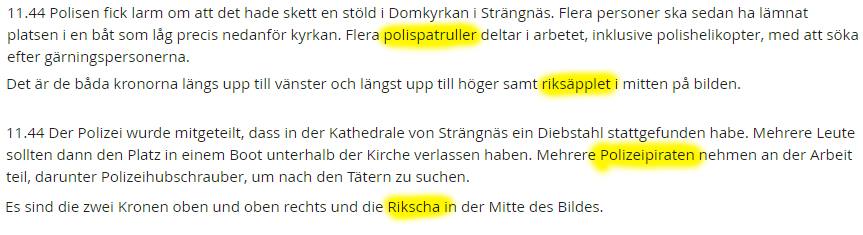
Ich hätte jetzt gedacht, die Piraten wären eher die anderen gewesen. Vermutlich chinesische solche, unter den Umständen.
Übersetzung von Google, Textausschnitte von mir.
https://polisen.se/aktuellt/handelser/2018/juli/31/31-juli-13.22-stold-strangnas/
2018-07-29
Doing nothing, now or laterScheduled tasks with idle condition
Problem: You use Group Policy to create a scheduled task that runs only after the computer has been idle for some time.
If your task has a time trigger, you notice that the task runs based on the trigger only and ignores the idle condition. If it is an “on startup” task, it does not run at all. (“On startup” plus idle condition means “run as soon as the idle condition is satisfied”.)
Analysis (note: “Task” means “task with an idle condition”):
Observations
-
The task scheduler obeys an idle condition in a task only after the computer has been restarted after the task was configured.
-
Any change to the task definition interrupts the idle condition, including GP pref application in Update (event 140, updated) mode. (In Replace mode the task definition is deleted and recreated, resulting in a new task.)
-
GP prefs are applied during any GP update.
-
The first GP update happens after the time when startup tasks are triggered.
-
A task scheduled to run “on startup” does not run until the next startup after it was configured.
-
Setting the “apply once” pref option prevents the pref item from being applied more than once.
Conclusions
- (1, 2) A time-triggered task from GP pref will always run based on the time trigger only.
- (2, 3, 4, 5): A startup task from GP pref will not run at all.
- (2, 3, 4, 6) A task from GP pref that is set to “apply once” runs based on the configured conditions.
Solution
Configure the task as a startup task and set “apply once”, as well as an appropriate “wait for idle” period. Each time the definition is changed, the “apply once” option must be cleared, the task saved, the option set again, and the task saved. This changes the unique ID and the target systems will apply the pref at the next GP update. The task will then run after the next startup, when the pref will again not be applied due to the filter. This has the downside that filter IDs will accumulate on the target systems.
A startup task without an idle condition will run unless preempted by a GP update.
Commentary
This is, of course, all necessary only because there is a bug in the Windows 10 task scheduler that causes the behavior in no. 1 above. It should be noted, however, that no. 1 is also the statement that I am least confident about. My observations are consistent with it being true, but it is possible that the behavior can be explained in a way that does not require such an egregious bug.
2018-07-20
It gets better with age“The Seoul-based Shinil Group said its divers discovered a wreck it identified as the 6,200-ton Dmitrii Donskoi, which went down during the 1904-1905 Russo-Japanese war off an eastern Korean island. The company speculated about 200 tons of gold bars and coins that are worth 150 trillion won ($132bn) would probably still be aboard the ship.”
That must be some seriously powerful gold, to be worth 16.5 times the current market price.
#DiurnariusNonCalculathttps://www.wolframalpha.com/input/?i=(1.3e11+usd+%2F+price+of+gold)+in+kg
https://de.pons.com/%C3%BCbersetzung/deutsch-latein/Journalist
2018-06-23
Was ist das Gegenteil von Speicherdichte?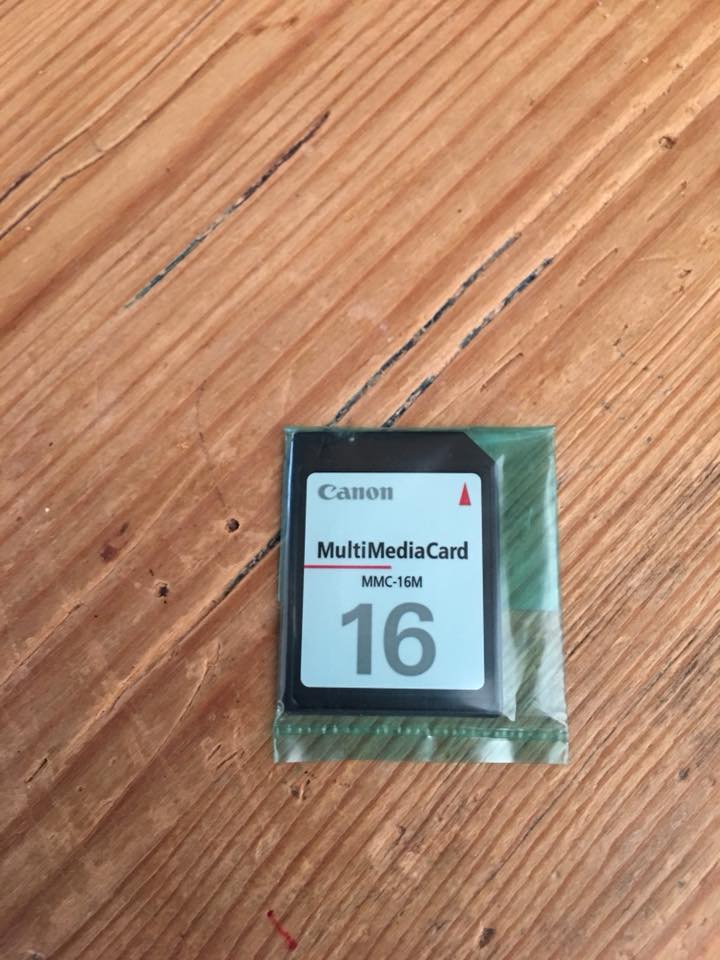
Beim Aufräumen gefunden … originalverpackt …
2018-06-05
ZehenspitzenLanxess-Arena, ziemlich weit rechts vorne, ziemlich weit unten(, ziemlich schwerhörig im Moment) -> Bf Deutz in 14 Minuten.
Danke, Vibram FiveFingers.